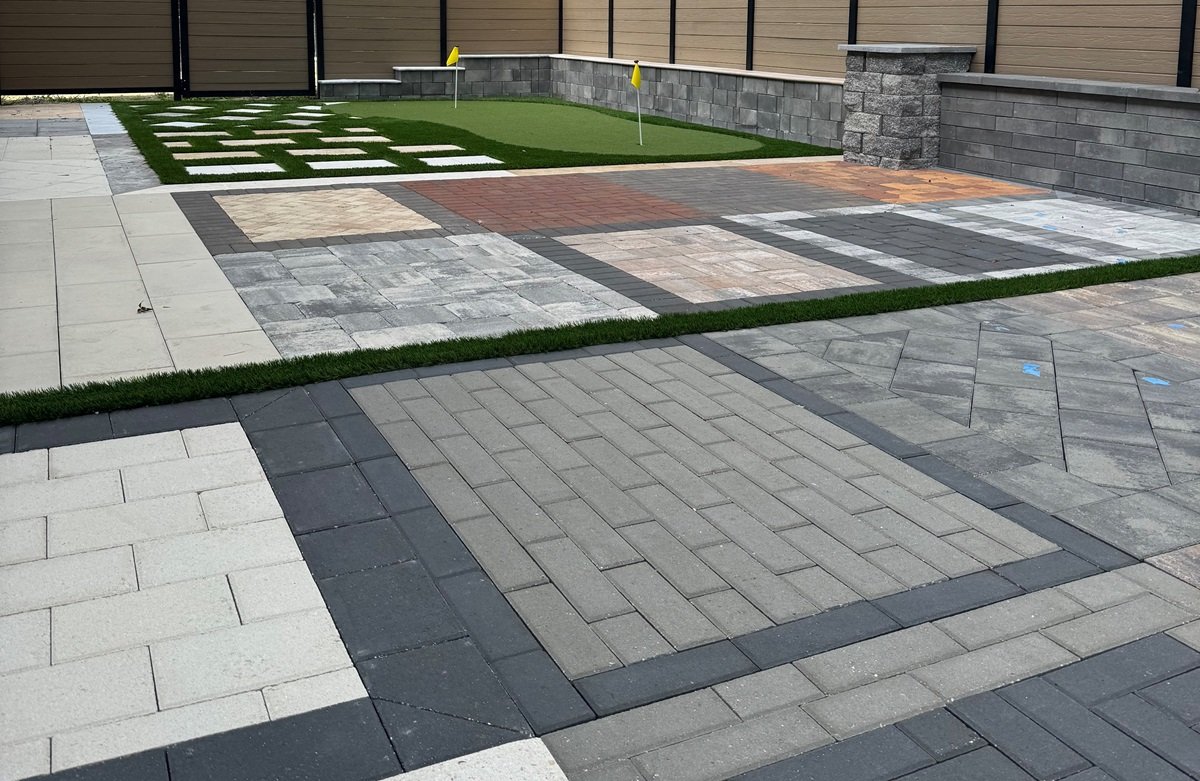
Choosing a Paver Material for the Florida Climate Is an Engineering Decision
Most homeowners choose a paving material the way they choose a floor tile: by looking at samples and picking the one that suits the house. In a temperate climate that works well enough. In South Florida, where surfaces face ultraviolet exposure year round, salt laden air near the coast, chlorinated water around pools and rainfall that arrives in intense bursts, material selection is closer to a performance specification than a finish decision.
The good news is that the trade offs are well understood and the shortlist is short. Six material families cover almost every residential application in the region, and each has a set of conditions where it is clearly the right answer.
Concrete Units Remain the Value Benchmark
Manufactured concrete pavers meeting the ASTM C936 standard are the most widely installed product in the region and the least expensive, generally starting near twelve dollars per square foot fully installed. They are dimensionally consistent, available in a wide range of formats and colours, and they perform well under vehicle loading, which makes them the default for driveways.
Their limitation is surface temperature and colour longevity. Darker concrete units absorb significant heat, and pigment can fade under sustained ultraviolet exposure. Sealing mitigates both to a degree, and lighter colour selections make a substantial difference to comfort underfoot.
Travertine Owns the Pool Deck
Travertine has become the default around South Florida pools for reasons that are physical rather than fashionable. The stone stays comparatively cool underfoot in direct sun, and tumbled and brushed finishes typically achieve a wet dynamic coefficient of friction at or above the 0.60 threshold commonly specified for wet pedestrian areas. It also resists chlorine and salt exposure well.
Installed pricing generally begins in the high teens and can reach the mid to high twenties depending on format and finish. Travertine is porous, so jointing and sealing matter more than they do with denser materials, and it is better suited to pedestrian areas than to driveways carrying regular vehicle load.
Porcelain for Continuous Indoor to Outdoor Floors
Exterior grade porcelain is the most technically capable surface in the group and the most expensive, commonly running from around twenty dollars per square foot into the low thirties installed. It is effectively non porous, highly resistant to staining and fading, and available in textured finishes engineered for wet slip resistance.
Its principal appeal is design continuity. Because porcelain is produced in formats that match interior tile, it allows a patio floor to read as an extension of the room behind it. That precision comes with a demand for exacting substrate preparation and cutting, which is why firms specialising in South Florida paver installation such as the Boca Raton based contractor Craft Pavers treat porcelain as a specification requiring tighter tolerances rather than simply a more expensive unit.
Natural Limestone and Clay Brick
Natural limestone, generally from the high teens upward, offers a softer, quarried appearance that suits traditional and Mediterranean architecture common across Palm Beach County. Like travertine it is porous and benefits from sealing.
Clay brick, typically from around fourteen dollars per square foot, has the longest colour stability of any material in the group because the colour is inherent to the fired clay rather than applied as pigment. It suits historic and coastal vernacular architecture and holds its appearance for decades, though its format range is narrower than manufactured alternatives.
Permeable Systems Where Coverage Rules Bind
Permeable interlocking paving, commonly from around fourteen dollars per square foot installed, uses widened joints filled with open graded aggregate over a stone reservoir so that rainfall infiltrates rather than running off. On lots constrained by impervious surface coverage limits, which apply across much of Broward and Palm Beach County, these systems can make an otherwise unpermittable design viable.
They require a deeper open graded base and periodic joint maintenance to prevent clogging from organic debris, and they are not appropriate on every subgrade. Where they do fit, they solve a regulatory problem and a drainage problem simultaneously.
Format and thickness matter alongside material family. Larger format units cover ground quickly and read as calm and contemporary, but they are less tolerant of an imperfect bedding course and are generally unsuitable under vehicle load. Smaller units interlock more effectively, absorb minor irregularities better and are the safer choice wherever loading is significant.
Matching Material to Application
A workable rule of thumb for the region runs as follows. Driveways carrying vehicle load favour concrete units or clay brick over a six to eight inch compacted base. Pool decks favour travertine or textured porcelain for temperature and slip performance. Patios can take any of the group, with porcelain preferred where indoor continuity matters. Walkways and garden paths are the natural home for permeable systems.
Whatever the selection, the assembly beneath it does not change: geotextile separation over the prepared subgrade, compacted crushed limestone sized to the load, a screeded bedding course, mechanical edge restraint and marine grade polymeric jointing. The material determines how the surface looks and feels. The base determines how long it stays that way.